DOC vs DOCG vs IGT: what Italian wine labels promise
DOCG is the strictest Italian wine tier, DOC the middle and IGT the loosest. Here's what each label guarantees and what it leaves open.
By Jeremy Young · Published November 9, 2026 · 6 min read
Key takeaways
- DOCG is the top Italian tier: every DOCG wine from each producer is analysed and tasted by a government-licensed panel before bottling, then sealed with a numbered government strip across the cap or cork.
- DOC wines must be made in a specified area and follow rules that usually cover grape varieties, yields, minimum ageing and minimum alcohol.
- IGT requires at least 85% of the grapes to come from the named zone, and the zones are usually far larger than DOC areas.
- The first DOCGs were Brunello di Montalcino, Vino Nobile di Montepulciano and Barolo in July 1980, and a rush of new DOCGs in 2010 to 2011 may have diluted the tier.
- Since the 2008 EU reforms, DOC and DOCG are protected as DOP and IGT as IGP, so a modern label may use those letters instead.
DOC, DOCG and IGT are the three tiers of Italian wine law, and the letters tell you how tightly a wine is ruled. IGT is the loosest. It names a broad area and asks for little. DOC fixes the grapes, the yields and often the ageing for a defined place. DOCG is the top tier, usually with stricter versions of those rules, plus a tasting panel and a numbered seal on the bottle.
The letters describe how a wine is made and where it comes from. They can't tell you whether you'll like it.
I'm tasting at least one wine from every DOC and DOCG in Italy. This site tracks 411 of them: 79 DOCG and 332 DOC. That's a lot of rulebooks, so here's the short version of what the letters mean.
What's the difference between DOC and DOCG?
DOC stands for denominazione di origine controllata. It requires that a wine meet a defined quality standard and be made within a specified area. Each DOC then writes its own rulebook. That usually covers the permitted grape varieties, harvest yields, minimum ageing (including time in barrel) and minimum alcohol.
DOCG adds e garantita, which means 'and guaranteed.' It's meant as a step above DOC, and the guarantee is checked in a specific way. All DOCG wines from each producer are analysed and tasted by a government-licensed panel before they're bottled. Wines that pass get a numbered government seal across the cap or cork, so the contents can't be tampered with later. A wine that fails the checks can't be sold as DOCG.
Where a DOCG is a tightened version of an existing DOC, the extra rules are usually some mix of the following: a lower share of blending grapes, lower yields, higher minimum alcohol and longer ageing.
The Italian rules also say a DOCG is reserved for wines that have already been DOC for at least ten years and are judged to be of particular merit. Both tiers share one small rule: the bottle can't hold more than 5 litres.
The name on the label is either a place or a historic product name tied to a place. Barolo is a town in Cuneo province in Piedmont. Vino Nobile di Montepulciano is the historic name of the wine made around Montepulciano, in Siena province.
What does IGT mean on an Italian wine label?
IGT stands for indicazione geografica tipica. It was created in 1992 to recognize the unusually high quality of the Super Tuscans. IGT wines carry the name of the locality where they're made, but they don't meet the stricter DOC or DOCG requirements. Those are generally written to protect traditional formulas such as Chianti or Barolo.
The rules are looser in two ways. The grapes must come from the named zone for at least 85%, and the zones tend to be huge, often a whole region or a big part of a province. An IGT wine can show its colour, its grape variety and its vintage on the label. Italy treats IGT as a higher tier than plain table wine.
Why does a wine end up as IGT? Sometimes it's a commercial choice. Sometimes the grapes or the method can't fit inside the DOC or DOCG rules for the area. So an IGT label isn't a verdict on quality. It tells you the wine sits outside a traditional formula.
One recent example: in 2022 Abruzzo was granted its own IGT, Terre d'Abruzzo. And the Italian-language list shows Piedmont with no IGT at all, even though it has plenty of DOCG wines, including Barolo, Barbaresco and Gavi.
Two regions use their own words. In the Aosta Valley a wine may say vin de pays in place of IGT. In Bolzano it may say Landwein.
Is DOCG always better than DOC?
No, and the history explains why. DOCG was created because many in Italy's food industries thought DOC had been handed out too liberally. The new tier was made as similar as possible to the old one so buyers would recognize it, but it was meant to be a different level of quality.
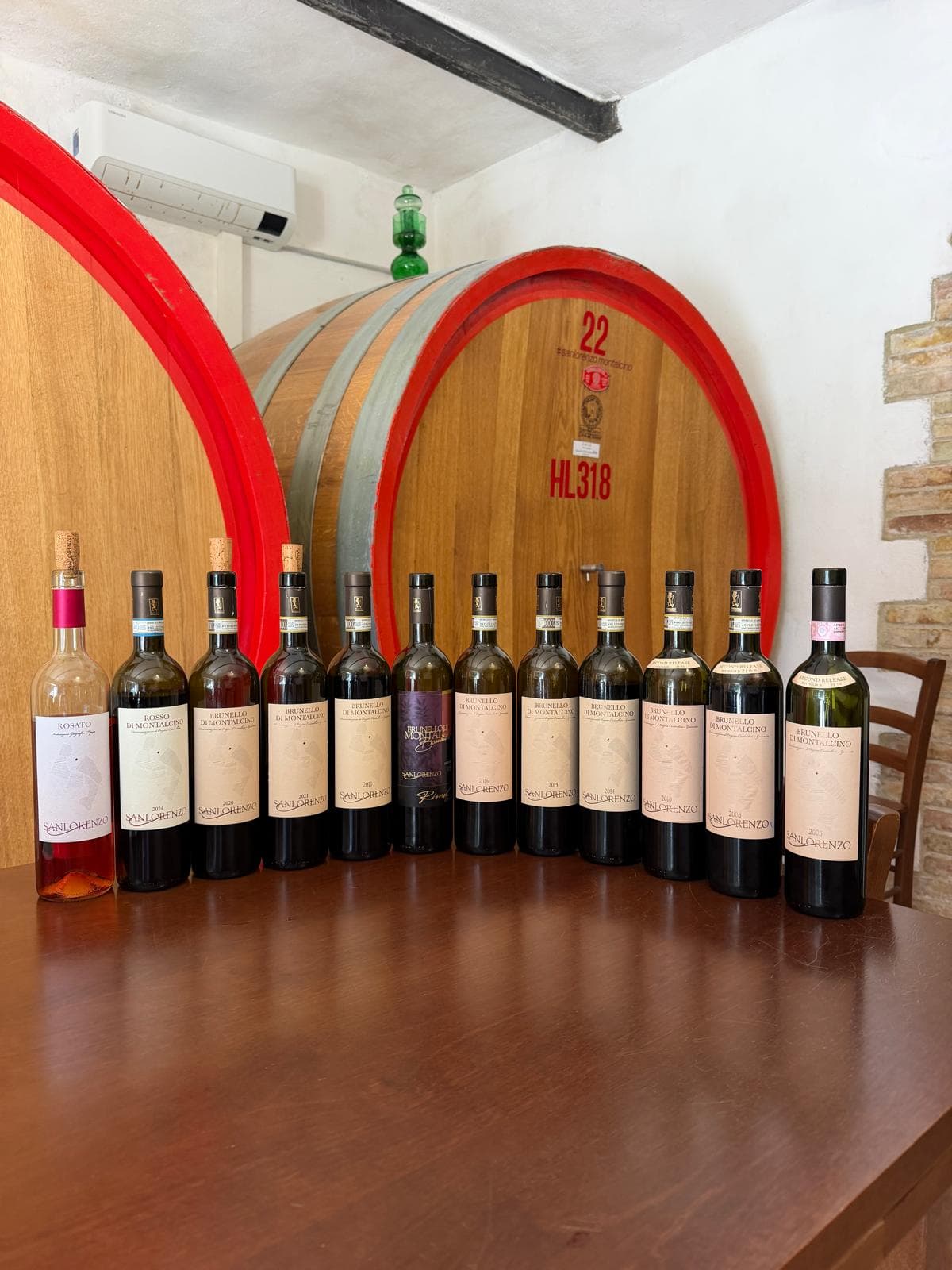
The first DOCGs were Brunello di Montalcino, Vino Nobile di Montepulciano and Barolo, all approved by presidential decree in July 1980. Barbaresco followed three months later.
Then came a rush. In 2010 to 2011 many new DOCGs were created or lifted from DOC so they could be registered before the EU reform deadline. That has potentially diluted what the letters mean. A DOCG from 1980 and one from 2011 may not stand for the same thing. I treat the letters as a starting point and let the glass decide.
Size varies enormously too. Moscato di Scanzo in Lombardy is the smallest DOCG in Italy, with 39 producers and 31 hectares of vines, all in the single commune of Scanzorosciate. At the other end, Chianti covers the provinces of Arezzo, Florence, Pisa, Pistoia, Prato and Siena in Tuscany, with subzones such as Rùfina. Chianti Classico has had its own rulebook, separate from the rest of Chianti, since 1996.
Some DOCGs go a step further and allow an extra geographical mention on the label, a subzone or even a single vineyard. Barolo does this. The Italian description calls that the top of the pyramid.
And not every region has the top tier. As of 31 August 2025, the Italian-language list shows no DOCG in Liguria, Molise, Trentino-Alto Adige or the Aosta Valley.
What do Classico and Riserva add?
These are extra words on top of DOC and DOCG, and they're regulated too.
Classico is reserved for wine made in the area where that type of wine has traditionally been made. For Chianti Classico, that area is defined by a 1932 decree.
Riserva is for wines aged at least two years longer than normal for that type of wine. Since each DOC and DOCG writes its own ageing rules, the exact timing differs from one appellation to the next. If it matters to you, check the rulebook for that wine.
Some DOCGs are built around the Riserva idea. Castelli di Jesi Verdicchio Riserva in Marche is one example, and Taurasi in Campania comes in normal and Riserva versions.
How do I read the letters on a bottle today?
You may not see DOC or DOCG at all. Since the 2008 EU reforms, both are protected in the EU as a protected designation of origin, which Italy usually writes as denominazione di origine protetta, or DOP. IGT is equivalent to the EU's protected geographical indication, and many producers now write the Italian version, indicazione geografica protetta, or IGP.
In practice, that means a label might say DOP where an older one said DOC or DOCG, and IGP where an older one said IGT. Producers may still use the old letters, and many do.
Bolzano and the Aosta Valley add their own language. In Bolzano you may see kontrollierte Ursprungsbezeichnung for DOC. In the Aosta Valley it's dénomination d'origine contrôlée.
The system itself dates to 1963, modelled on the French appellation d'origine contrôlée laws. It was overhauled in 1992 and registered with the EU by the end of 2011. Italy's agriculture ministry now counts 522 designations for wine across DOP (DOCG and DOC) and IGP (IGT).
Here's how I use all this. IGT gives you a rough location. DOC and DOCG give you a rulebook, and DOCG adds a panel's sign-off. What's in the glass is a separate question, and it's the one I'm answering one appellation at a time.
Questions people ask
What is the difference between DOC and DOCG?
Both tie a wine to a defined area and a set of production rules. DOCG is meant as the superior tier: wines are tasted by a government-licensed panel before bottling and carry a numbered seal, and the rules are usually stricter than the DOC they refine.
Is IGT lower quality than DOC?
IGT is a looser category, with larger zones and fewer rules. Some wines sit there by commercial choice, or because their grapes or method don't fit a DOC rulebook, so the letters alone don't settle quality.
Does DOCG guarantee a wine will taste good?
No. The guarantee covers origin and compliance with the rules, checked by analysis and a tasting panel. Because many DOCGs were created or elevated in 2010 to 2011, the letters carry less weight than they did in 1980.
What do DOP and IGP mean on an Italian wine?
They are the EU terms. DOC and DOCG are protected as DOP, and IGT is equivalent to IGP. Producers may use either the old Italian letters or the newer ones.
Where this comes from
- Denominazione di origine controllata (Wikipedia)“All DOCG wines from each producer are analysed and tasted by a government-licensed judgement panel before being bottled.”“This has had the effect of potentially diluting the importance of the DOCG classification.”
- Indicazione geografica tipica (Wikipedia)
- Denominazione di origine controllata e garantita (Wikipedia, Italian)“Le DOCG sono riservate ai vini già riconosciuti a denominazione di origine controllata (DOC) da almeno dieci anni”“È la più piccola Docg d'Italia con 39 produttori e 31 ettari di superficie vitata.”
- Indicazione geografica tipica (Wikipedia, Italian)“le uve da cui è ottenuto provengono per almeno l'85% esclusivamente da tale zona geografica”
- Masaf - Qualità“522 DOP ( DOCG , DOC ), IGP (IGT) dei vini”
About the author
Jeremy Young is tasting at least one wine from every DOC and DOCG in Italy and reviewing each one here, with a score and a note on how he got the bottle. He edits and signs off every article on the site before it goes live. More about Jeremy and the project.
Get the reviews by email
One email per bottle
When I publish the next review, you get it. No digests, no roundups. Unsubscribe whenever.