An Early Harvest in Tuscany: Ten Estates and the 2020 to 2024 Vintages
Notes from 10 estates in Lazio and Tuscany after a harvest that was mostly over before we arrived: how the 2020 to 2024 vintages turned out, what each winery poured, and my scores.
By Jeremy Young · October 16, 2026 · 33 min read · 62 wines reviewed
When we landed in central Italy in late September, I pictured crews working the rows and cellars running flat out at the peak of the season. That isn't what we found. The vines had already been picked, the crush pads were washed down, and the new wine was well into fermentation. The 2026 harvest came so early that most of it was over before our first winery visit.
Grower after grower across Tuscany told us this was one of the earliest harvests they could remember. A few Montalcino producers started on their Sangiovese before August was out. In Chianti Classico, where picking often runs deep into October, much of the fruit was in weeks ahead of the usual calendar. So by the time we showed up, nobody was asking when to pick. They wanted to talk about how the new wines were shaping up in the cellar.
That turned out to work in our favor. With the rush behind them, winemakers had time to sit with us, pull older bottles, and speak frankly about the seasons behind each wine. We went to 10 estates in Lazio and Tuscany and tasted deeply across the 2020, 2021, 2022, 2023, and 2024 vintages, plus a number of older wines and a few barrel samples that look very promising.
What I took away first is how far apart the vintages can swing from one corner of central Italy to the next. Chianti Rufina's vineyards are higher and cooler. Montalcino's hills soak up the sun. Bolgheri's vineyards feel the sea. Each place reacted in its own way to drought, heat, frost, and the occasional unusually wet season. The producers who know their vineyards best, and who have learned to work with weather that gets harder to predict every year, are making remarkable wine.
The year that stood out most was 2021, in Montalcino above all. The top 2023s from Bolgheri and Chianti Classico were every bit as convincing. And while Chardonnay gets much of the attention when people talk about great white wine in other parts of the world, some of the most memorable surprises of the trip were Tuscany's best Sauvignon Blancs, Grechettos, and other native varieties.
How the Five Vintages Played Out, 2020 to 2024
2020: Fresh, Fragrant, and Ready Early
The season opened on the dry side, with bud break coming in late March. A cold snap after that trimmed yields in some of the lower vineyards. Then warmer, drier weather settled in and held disease pressure down for most of the summer. The berries stayed small, which brought concentration, and the fruit ripened without many of the headaches a wetter year tends to bring.
Everything turned on September 25, when heavy rain fell over parts of Montalcino. Anyone who had already picked missed it completely. Others left their grapes on the vine another 10 days for extra ripeness. Those choices show up in the finished wines, mostly in how firm the tannins are and how concentrated the wine feels.
As a group, the 2020s lean toward freshness, perfume, and early drinking. Expect lively red fruit, floral aromas, and fairly soft tannins, which make them easier to enjoy young than the firmer 2019s. The best of them still have plenty of depth and should keep getting better over the next 10 years.
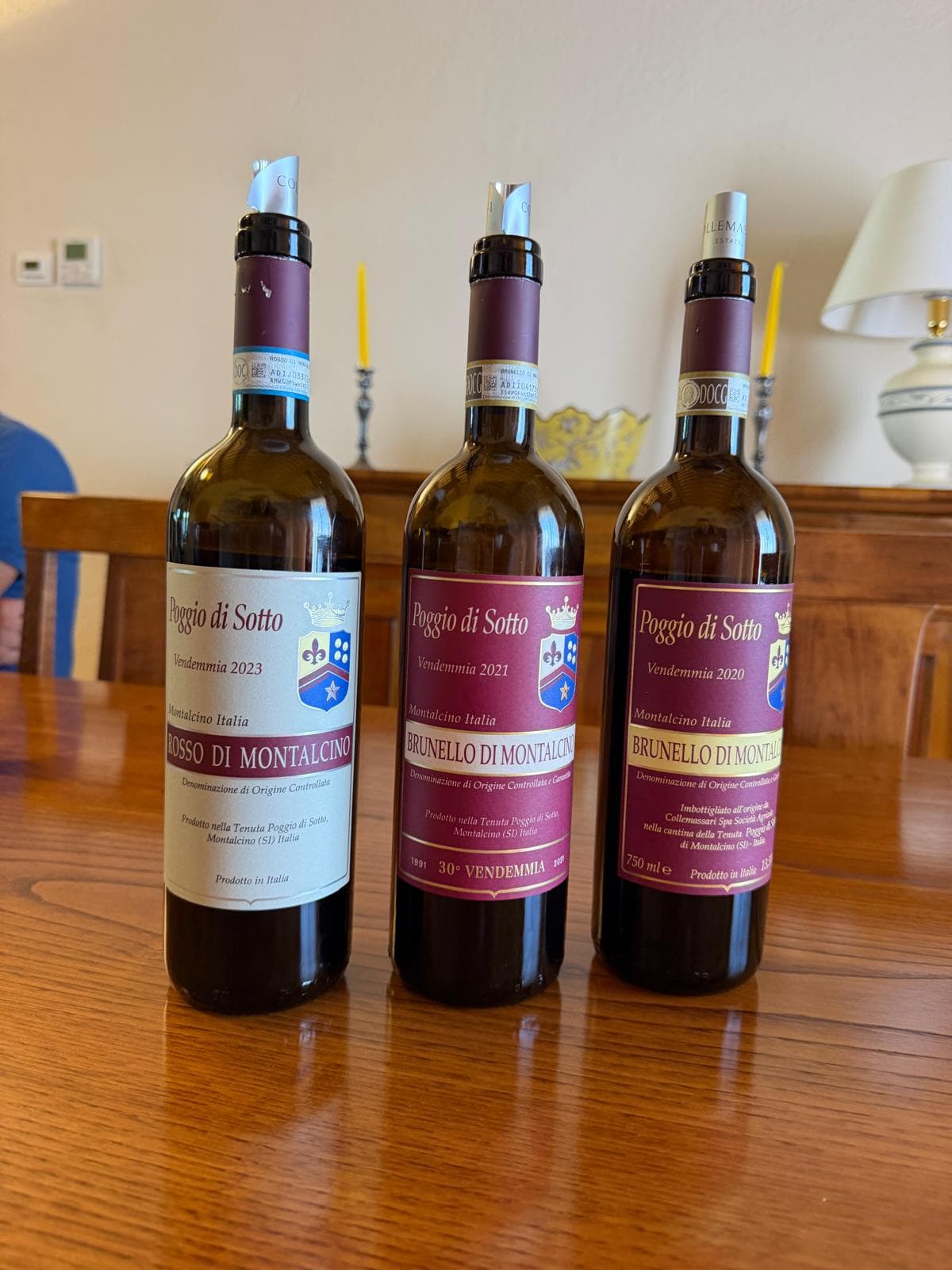
For proof of how complex a 2020 can get from a great site, look at the 2020 Poggio di Sotto Brunello di Montalcino, which earned 97 points from me. The 2020 San Lorenzo Brunello, at 95 points, pairs generous fruit with the freshness and balance that set the year's better wines apart. In general I'd treat 2020 as a vintage for the medium term, though a few producers made wines that belong in the cellar.
2021: Frost in April, Greatness in the Glass
Few springs in recent memory have been as rough as this one. Temperatures plunged on April 7 and 8, and a second cold spell hit on April 15, badly hurting the most exposed vineyards. The lower sites took the worst of it, and in some parts of Montalcino more than half the young buds were lost.
Hot, dry weather followed for the rest of the season, adding stress to vines that were already carrying a short crop. Old vines and vines in deeper soils coped best, thanks to established roots and the water held below. In the end, production came in roughly 15% under 2020. The grapes that made it through often had outstanding concentration and balance.
The Consorzio del Vino Brunello di Montalcino has called 2021 an outstanding vintage, and producers in Bolgheri are just as excited about what they made on the coast. Having tasted widely in both places, I see why. The top wines have intense fruit and refined structure, aromatic lift, and a freshness that points to a long life in bottle.
No wine on the trip beat the 2021 Poggio di Sotto Brunello di Montalcino, which I gave 99 points. It's precise and deeply layered, its structure fully woven in, and it ranks with the most compelling young Brunellos I've had in years. Giovanni Manetti at Fontodi was every bit as high on the vintage, and he puts 2021 in the company of his favorite years: 1990, 1993, 1995, 1999, 2016, and 2019.
If you collect, 2021 is the year to chase hardest, and Montalcino first. The wines have the concentration and backbone to age for a long time, and their balance is what impresses me most. The best of them should pay back decades of patience.
2022: Drought, Density, and a Surprising Lift
Drought defined 2022. From February until the middle of August there was very little rain and the weather stayed warm, so the vines were under real water stress. In some vineyards the plants all but stopped growing and ripening to hold on to moisture. That slowdown protected acidity, and the vintage ended up fresher than the weather would have led you to expect.
Rain in mid-August gave the vines a break and got ripening moving again, but the season stayed well ahead of its usual pace. Bolgheri started picking in the third week of August, and a lot of Chianti Classico producers began around September 10. The berries were small, the crop was short, and the fruit came in highly concentrated.
These are big, structured wines with dense fruit, firm tannins, and real depth. The surprise, tasting through them, was how well the best producers held on to freshness. Luca Marrone at Grattamacco cut the Merlot in his blend to about 13% that year and leaned harder on Cabernet Sauvignon. It was a small change, and it kept the wine from going over the top. I scored the 2022 Grattamacco Bolgheri Superiore 97 points. It's dense and smells of cedar, the tannins are dusty, and the finish brings dried bay and white pepper, yet it never turns heavy. From the hills around Siena, the 2022 Borgo Bonelli La Caccia (96 points, Editor's Choice) strikes the same balance between depth and poise.
In Chianti Classico and Rufina, the 2022s are tighter and need time. The 2022 Selvapiana Vigneto Bucerchiale Riserva (93 points) and the 2022 Badia a Coltibuono Chianti Classico Riserva (92 points) both have grippy tannins that will take a few more years to relax. In Montalcino, I tasted the 2022 San Lorenzo Brunello from barrel. It's due out in January 2027 and already shows ripe strawberry and Morello cherry with an iron-rich edge. Once it settles, I expect it to land at 95 to 96 points. Buy 2022 if you're willing to wait.
2023: Mildew Inland, Sea Breezes on the Coast
A wet spring set up the worst downy mildew outbreak in a generation. Rain kept coming through flowering, then warm, muggy days followed, which is exactly what the disease wants. Organic growers who couldn't get a spray on between storms were hit hardest. Giovanni Manetti put Fontodi's losses at 30 to 40% across the estate, and Chianti Classico as a whole made only about 200,000 hectoliters. Parts of Montalcino then took a violent hailstorm on August 15, and temperatures in July and August came close to 40°C.
Bolgheri had a different year. Wind off the sea dried the vines fast after every rain, and the coast mostly avoided the mildew that wrecked so many inland vineyards. Marco Balsimelli of Ornellaia calls 2023 a benchmark season. Spring rain refilled the soils, the summer was sunny and dry, rain came in August right when it was needed, and a dry September let every variety and plot be picked when it was ready. Luca Marrone at Grattamacco told us much the same: compared with 2022, the 2023 harvest came later, with lower alcohol and smoother tannins.
You can taste that split in the wines. I gave the 2023 Ornellaia 99 points. It's ripe, dense, and creamy, with boysenberry, cassis, and sweet baking spice over dusty tannins, and Marco thinks it will age for 30 years or longer. The 2023 Grattamacco Bolgheri Superiore (97 points) goes the saline, savory route, with dried mint and fresh leather. The 2023 Grattamacco L'Alberello (96 points) comes from one vineyard where Cabernet Sauvignon and Cabernet Franc are fermented together, and it opens with forest and spearmint.
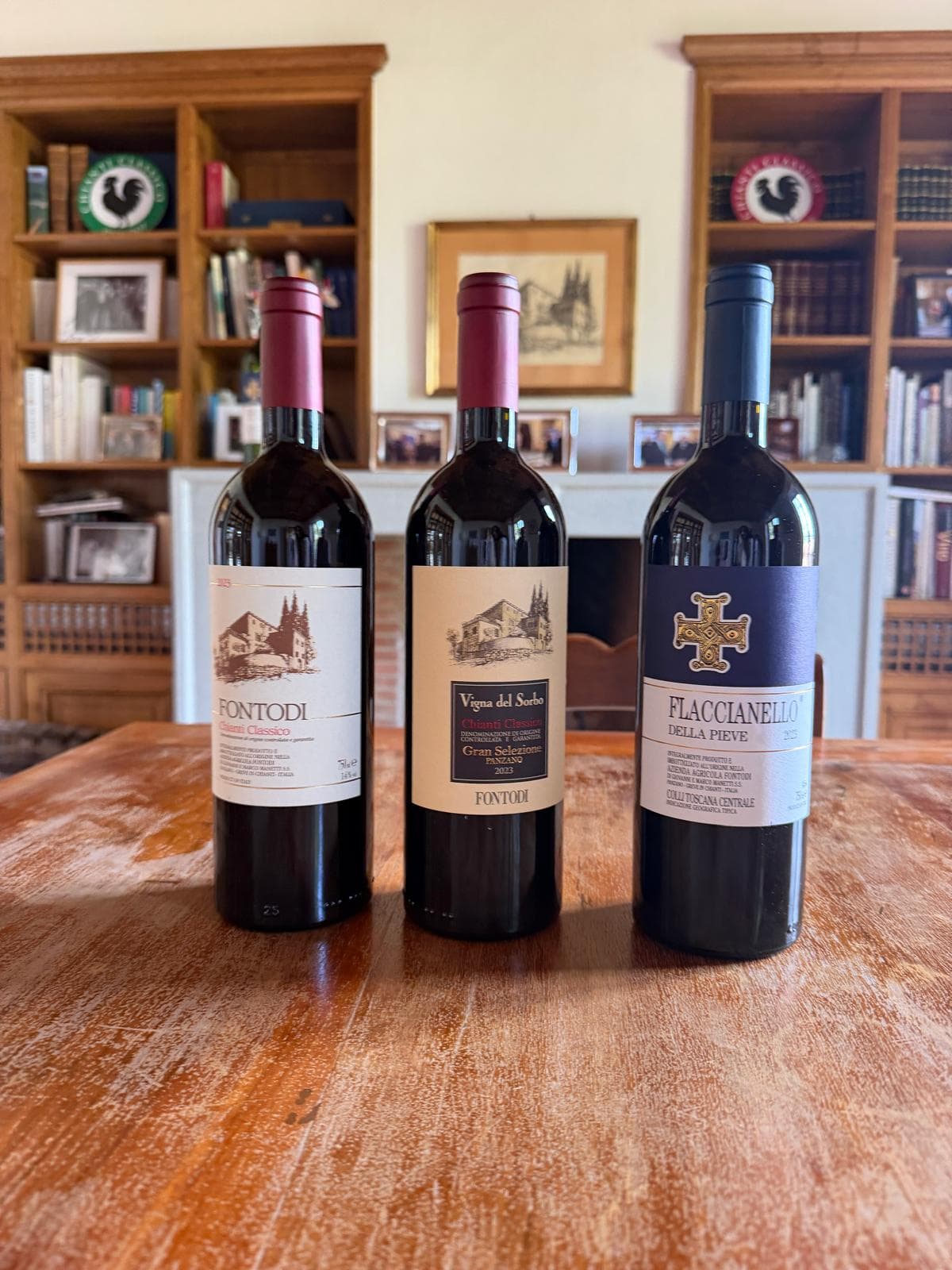
Inland, the estates that got through the mildew made surprisingly rich wines, partly because the small crop left each vine with lots of leaves for very little fruit. The 2023 Fontodi Flaccianello, which I scored 98 points, manages power and elegance together: ripe black cherry, dried iris, and mulled spice riding on fine, grippy tannins. The 2023 Fontodi Chianti Classico Gran Selezione (96 points) is the more savory of the two, with blackcurrant and wild thyme over a mineral streak that comes from schist. Overall, 2023 is a warm, generous vintage, and its top wines have the structure to age.
2024: Cool, Wet, and a Throwback to the 1990s
The 2024 season flipped almost everything about the year before. After a normal winter and a mild February, bud break came a little early. Then late April and May went cool, and through June it rained nearly every day. Growers sprayed nonstop to keep disease away, and after 2023 everyone was on edge. July finally turned hot and dry, often above 35°C, and August brought storms with patches of hail. One hailstorm alone cost Badia a Coltibuono 45% of its crop. From late August through September the weather was cool and wet, and wide gaps between day and night temperatures dragged ripening out into late October.
Chianti Classico made about 305,000 hectoliters, its biggest crop since 2019, and the wines are clearly leaner. Alcohol is in the 12 to 13% range, acidity runs high, and more than one producer told us the year reminds them of the 1990s. At their best the wines are fragrant, nimble, and lively with food. The weaker ones can go thin in the middle. Marco Balsimelli measured more than 1,000 millimeters of rain at Ornellaia for the year, against an average of 700. Most of it fell in winter and spring, though, and the summer stayed dry enough to give a fresher, less concentrated vintage than 2023.
In a cool, high site, 2024 can be lovely. The 2024 Selvapiana Chianti Rufina (93 points) has dried Bing cherry, fresh strawberry, and rose petals, with grippy tannins and bright acidity. On the coast, where the year gave fresh, balanced wines, the 2024 Grattamacco Bolgheri Rosso (94 points) and the 2024 Ornellaia Le Volte (93 points, Best Buy) are both excellent values. The whites were especially strong. The 2024 Ornellaia Poggio alle Gazze and the 2024 Grattamacco Bianco each earned 94 points from me, and they rank with the best white wines I've had from Tuscany. Drink the 2024 reds over the next several years instead of laying them down for the long haul.
Estate by Estate
Trebotti in Castiglione in Teverina, Lazio
We started in Lazio, in the tufa hills of Tuscia, about an hour and a half north of Rome. The Botti family has worked this land for 180 years. The estate's name joins "tre" and "Botti" for the three siblings in charge today. The owner is an agronomist who studied at Tuscia University and in Montpellier, then took over the land his grandparents left him.
Trebotti has been organic for more than 20 years. In 2019 it was certified carbon neutral, the first wine grower anywhere in the world with that designation. Each bottle carries its own number. The estate is a member of the Italian Federation of Independent Winegrowers, a group of 1,800 growers who handle every step themselves, from vineyard to bottle.
The vines grow in volcanic soil, and you taste it in every wine. Grechetto from here is unusually high in catechins, the polyphenols behind the whites' faintly bitter finish and their knack for aging. The 2007 Trebotti Incanthus Grechetto made the case on its own. After nearly 20 years in bottle it had moved into brown mushroom, dried sage, powdered ginger, and lemon confit, and it has another 10 years ahead of it. I scored it 93 points. The 2024 Incanthus (91 points) shows the grape young: chanterelle, acacia blossom, and a salty, earthy finish.
The 3S wines are named for sustainable and sulfite-free. They're made under a European patent the family developed with Tuscia University 14 years ago, which lets them make clean wines that don't oxidize, with no added sulfites. The 2023 Trebotti 3S Grechetto (92 points) aged 6 months in chestnut barrels, something this part of Lazio has done for 600 years. It has real textural depth, with dried yellow flowers, preserved lemon, and a long, softly nutty finish.
The reds come with local names. Here Montepulciano goes by Violone, and Sangiovese is called Grechetto Rosso. The 2022 Trebotti Castiglionero Violone (92 points) is named for the village of Castiglione and for its nearly black color. It shows the savory, mountain side of the grape, with black pepper, dried oregano, and a noticeably salty finish. The 2021 Trebotti Gocce Violone, the estate's cru, spends 2 years in neutral French oak and earned 93 points. It ships in zero-waste packaging, including a reusable cloth you can send back for a discount. Poured next to it, the 2013 Gocce (also 93 points) showed how well a hot, dry year can age, with pink peppercorn, dried strawberry, and lemon thyme over smooth tannins.
The owner also heads the local appellation association. He's pushing to rebuild the Tuscia designation as a mono-varietal appellation that uses native grapes only: Grechetto, Violone, Aleatico, Roscetto, and Procanico. He'd like it done within 3 years. His problems are the ones we heard from growers all over central Italy. This year the vineyards went 80 days in a row without rain. About 100 wild boars live nearby and do real damage to the vines every year, and a controlled hunt each October keeps their numbers down.
We finished with the 2025 Trebotti Bludom Aleatico (92 points), a passito dessert wine. The grapes dry for a month, no sugar or alcohol is added, and it carries just 100 milligrams of sulfites, a small share of what most Sauternes has. The name plays on the owner's own, Botti Ludovico Maria. It ends on a long note of candied violet.
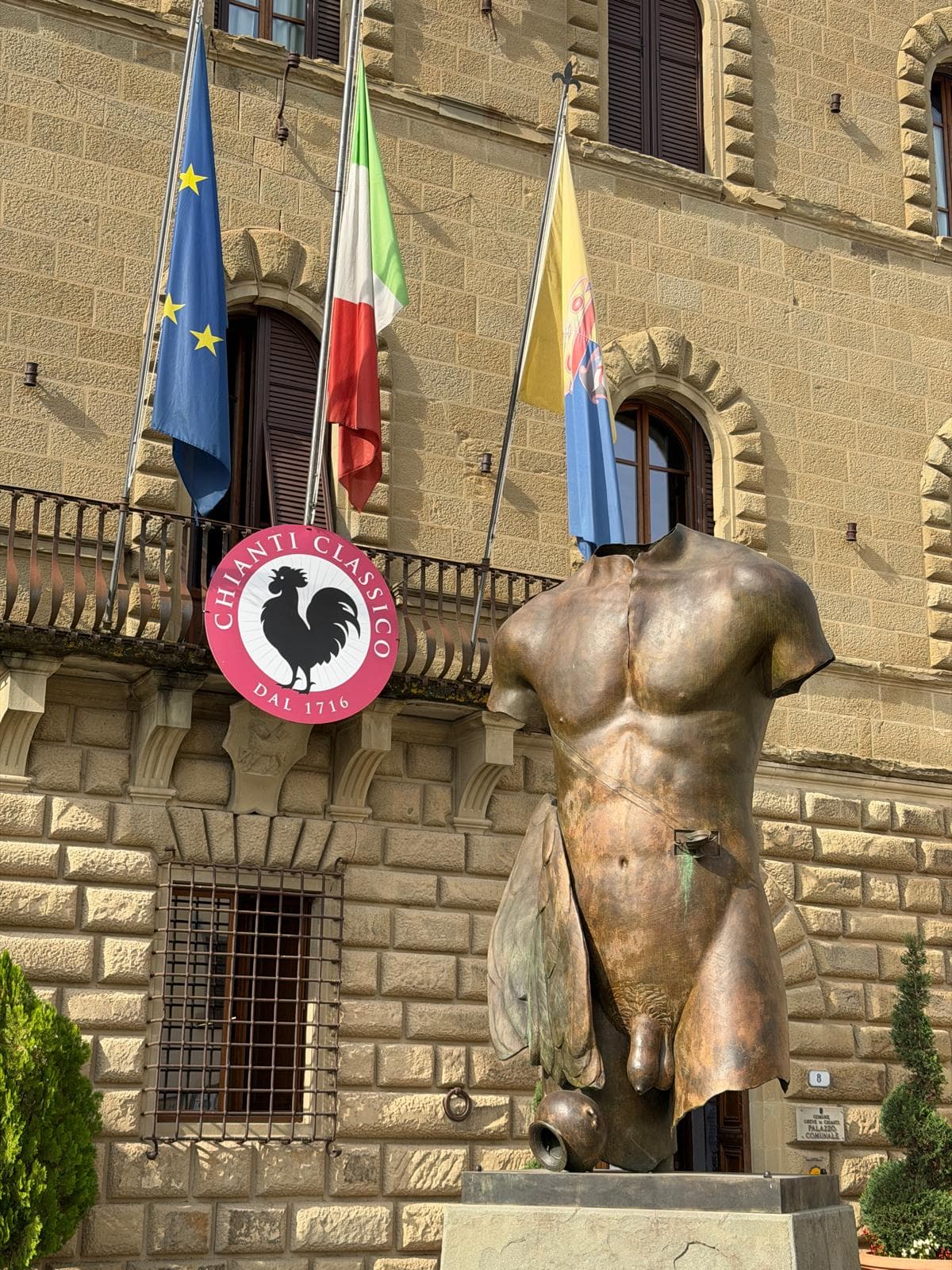
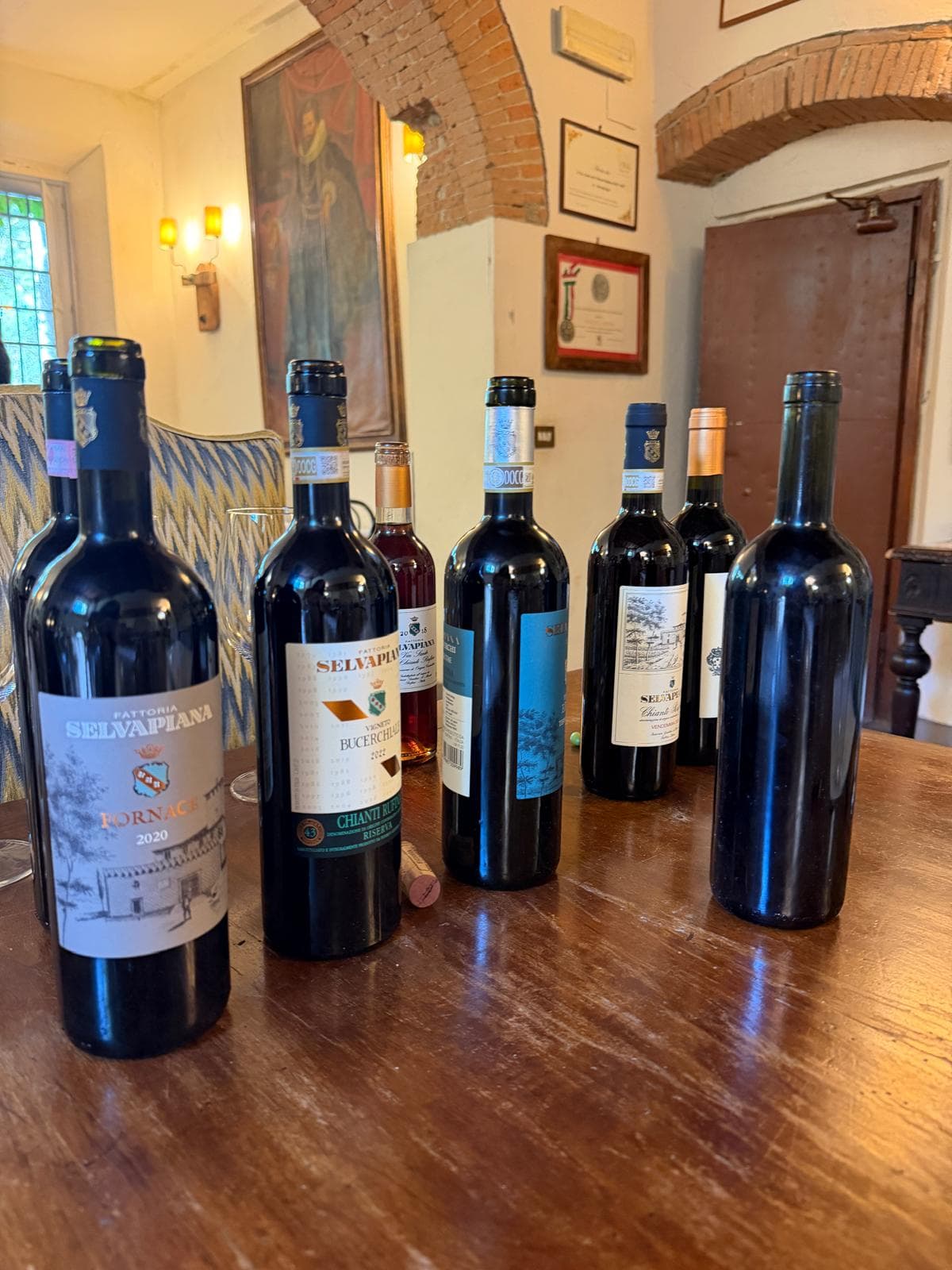
Selvapiana in Chianti Rufina
Federico Giuntini Masseti showed us around an estate that one family has owned since 1827. How it came to him is a story of its own. Francesco Giuntini, who ran Selvapiana for many years, never married and had no children. Federico's parents worked with him from 1950 to 1990, and Francesco adopted Federico and his sister, Silvia. The two of them run the estate now.
The next generation is already at work. Federico's son makes the wine, his daughter runs the office, and his youngest son is studying enology. Selvapiana makes 250,000 to 320,000 bottles a year, medium-small for Tuscany, and doesn't sell any of its grapes.
Rufina lies east of Florence in the Apennine foothills, and Federico says the mountains are what separate his wines from Chianti Classico. Monte Giovi climbs to about 1,000 meters and Monte Secchieta to around 1,700. Between them they send down a sheltering breeze and create big swings from day to night. His two top vineyards are near 500 meters in Dicomano, where being this far north counts as much as the elevation. The grapes ripen late, and they ripen in balance.
What you get is a Sangiovese that's finer, brighter in acidity, and lighter in build than the wines to the south. Federico says younger winemakers in Rufina are going after an elegance closer to Pinot Noir on purpose. In the cellar, that means whole berries, a cold soak, shorter macerations, fewer pump-overs, and native yeasts for every red.
The estate went organic in 1992, and Federico says the organic matter in the soil has doubled since. That's why he won't irrigate, even with summers getting hotter. He would sooner build up the soil and change rootstocks than count on water that may not be there later.
The barrels have changed as well. Until 2019, the reserve wines aged entirely in small barrels. Now 60 to 70% of the Bucerchiale and Erchi Riservas go into large casks, and the cellar's barrique count has fallen from about 500 to a little over 100. This year's harvest was the earliest Federico can recall, maybe even earlier than 2003. A heat spike in late August drove sugars up fast. Wetter spring weather, though, kept the vines in better health than they were in that notorious year.
The wines show the same restraint. The 2024 Selvapiana Chianti Rufina (93 points) blends fruit from every vineyard on the property, and it's genuinely elegant for $23. The 2020 Selvapiana Vigneto Erchi Chianti Rufina Riserva (94 points) has a salty, iodine, sea-breeze note from the vineyard's iron-rich soil, something you won't find anywhere else in Chianti. The 2010 Selvapiana Vigneto Bucerchiale Riserva, which I scored 95 points, smelled fresher than the 2015 we tasted next to it: dark cherry, tobacco leaf, and dried mint, with decades still to go. That bottle backed up Federico's belief that cool vintages outlast warm ones, even if they take longer to show it. His personal favorites are 1985, 1999, and 2019.
One sore point in Rufina is that the Gran Selezione category belongs to Chianti Classico alone. So the Rufina consortium made its own trademark, Terre Elette. It covers single-vineyard wines of 100% Sangiovese, with yields 25% under the legal limit, 30 months of aging, and one more year in bottle.
Selvapiana's library goes back to 1948, and Federico tasted the 1958 in Milan last winter. Over the years the cellar has crept from 14°C to 16°C, so air conditioning is now on the to-do list. The estate also makes one of Rufina's most sought-after olive oils from about 6,000 trees. They pick early, around October 10, for a peppery oil with notes of artichoke and tomato leaf, and it has gone to the River Cafe in London since 1987.
Badia a Coltibuono in Gaiole in Chianti
Vallombrosan monks built this abbey in 1051, one of three sister houses the order founded in the Chianti hills. Its bell tower, from 1150, still rises above the cloister. The monks left in 1810 and the property went into private hands. It has stayed with the same family since they bought it in 1846, the Giuntini line becoming Stucchi Prinetti through marriage. In the 20th century a Milanese head for business turned a farm that made wine for the family and the village into a commercial estate, with a restaurant, a guesthouse, and cooking classes. Our host told us that once the cloister door closes behind you, it's like going back 800 years.
The labels still carry the monks' symbols, and the winemaking holds just as tightly to the past. The vineyards were moved down from the abbey's 650 meters to sites at 200 to 400 meters, where Sangiovese can ripen fully, and about 70 hectares are planted today. What sets Coltibuono apart is its loyalty to Chianti's old grapes. Next to the Sangiovese grow Canaiolo, Colorino, Mammolo, Ciliegiolo, Pugnitello, Sanforte, and Malvasia Nera, along with white Malvasia and Trebbiano. All of them are propagated by massale selection from the estate's best vines, some of them 70 years old. Fermenting and bottling take place at the Monti winery nearby. Aging happens under the abbey church, in big Austrian and French casks: 12 months for the Chianti Classico, 24 for the Riserva.
Hail took nearly half the crop in 2024, so the 2024 Badia a Coltibuono Chianti Classico (90 points) is a small-production wine this year. It's bright, with sour cherry, cranberry, and dusty wild oregano. The 2022 Badia a Coltibuono Chianti Classico Riserva (92 points) brings white pepper, dried rose, and crushed underripe strawberry over dusty tannins, then a firm, savory finish.
The 2021 Badia a Coltibuono Cultus, which earned 93 points, is how the estate answers Gran Selezione. It spends 30 months in small French oak and blends several vineyards and all nine of the old varieties, and that blend is the very reason it can't use the Gran Selezione name. It starts savory, with peppery dried herbs, forest floor, and cured prosciutto, and then Bing cherry fills in. The 2021 Badia a Coltibuono Sangioveto (92 points) is its all-Sangiovese partner, layered with dusty rose, violet, and pink peppercorn.
The library reaches back to the 1937 through 1942 vintages, and only the lots that have aged best are held for sale. One tool in the cellar is a colmatore, an idea that goes back to Leonardo's time. It keeps the cask topped up and lets carbon dioxide out without letting oxygen in. Save room for the 2018 Badia a Coltibuono Vin Santo del Chianti Classico (92 points). Apricot, candied ginger, and roasted hazelnut lead to a finish like a grilled peach with a brown sugar glaze, and it has 20 years in front of it.
Borgo Bonelli in Casole d'Elsa
Borgo Bonelli is the youngest project here. It sits in the hills between Siena and Volterra, with American money behind it and a winemaking eye trained in Napa. The flagship, La Caccia, is a Super Tuscan blend whose makeup changes every year with what the vineyard delivers. A small 5-star hotel and resort is going up on the property, and it will rival anything in Tuscany. It's going to be stunning.
The 2022 Borgo Bonelli La Caccia, 96 points and an Editor's Choice, is built on 40% Cabernet Sauvignon and 30% Cabernet Franc, and it's only now hitting its stride. Think dark cherry, black currant, dried hibiscus, green peppercorn, and melted dark chocolate over velvety tannins. In the 2023 (95 points), Merlot rises to 22% and softens the edges, with dried strawberry, boysenberry, and lemon verbena. The 2024, which I tasted from barrel, moves to 39% Merlot and could end up anywhere from 95 to 97 points once it settles in bottle. I also tried a barrel sample of a Cabernet Franc Selezione that hasn't been released yet. Watch for it.
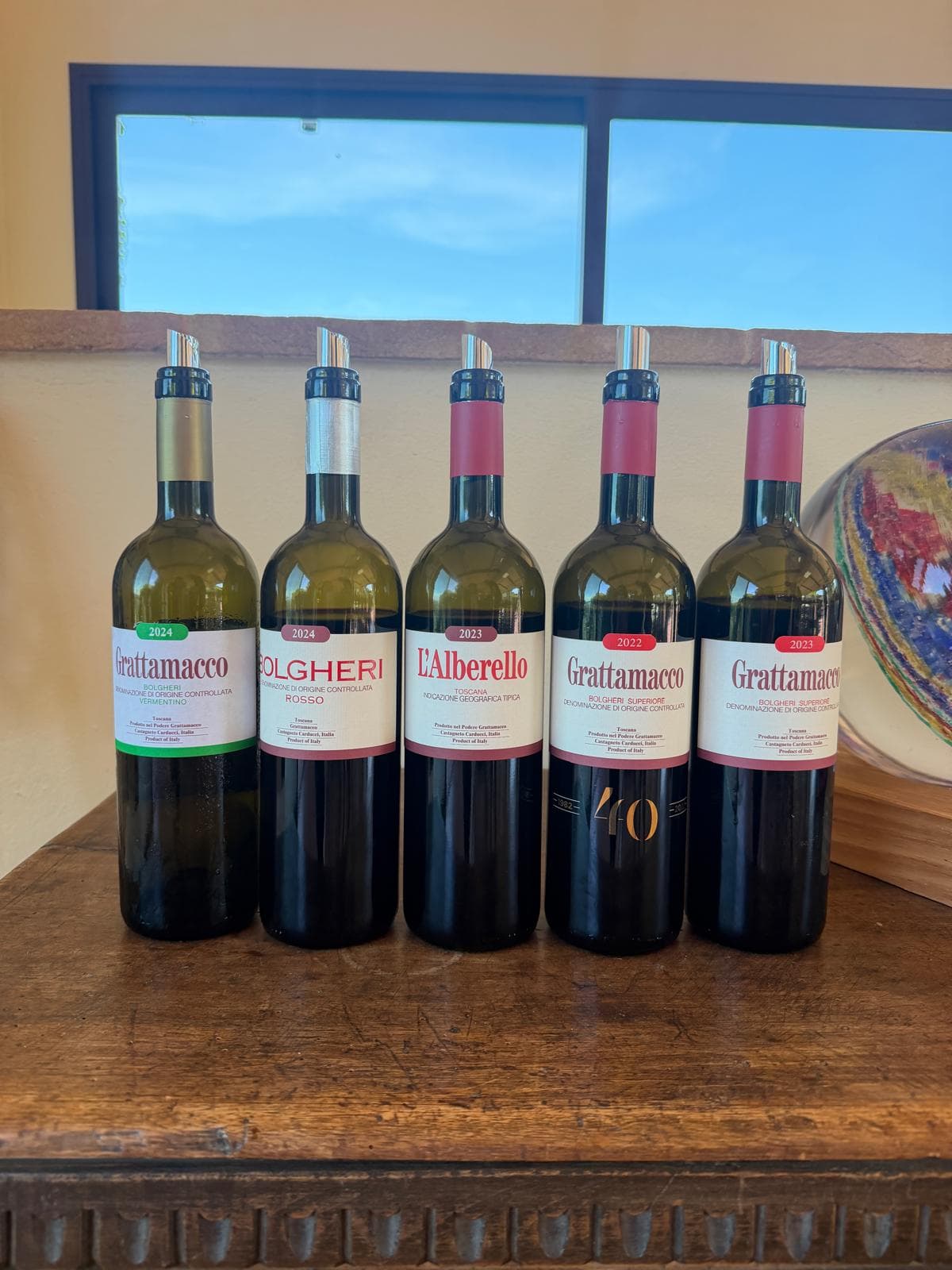
Grattamacco in Bolgheri
Grattamacco opened in 1977 as Bolgheri's second winery, after Sassicaia, and made its first vintage in 1982. Luca Marrone, its winemaker for more than 20 years, took us through an estate that led the way on organic farming along the coast and helped shape the appellation itself. The name comes from the hill. Its second half might go back to an Etruscan word for iron, or to a simple peasant dish. Either way, it says these soils are poor, better for vines than for much else.
The Tipa family, who also own Poggio di Sotto in Montalcino, started renting Grattamacco in 2002 and bought it in 2007. On their watch the vineyards went from about 10 hectares to 30 to 35, and Luca says they stopped there on purpose to protect the style.
Two decisions make Grattamacco different from its neighbors. The first is Sangiovese. Most of Bolgheri relies on Bordeaux grapes alone, while Sangiovese has been part of the Superiore from the start. Since 1995 the blend has settled at about 65% Cabernet Sauvignon, 20% Merlot, and 15% Sangiovese, and Luca tweaks it each year. In hot 2022 he dropped the Merlot to around 13% and added Cabernet. In 2023 he went back to the usual formula.
The second is how the wine ferments. The Superiore goes into small open-top wooden vats of about 700 liters, a slow, hands-on method modeled on Sassicaia that very few estates still use. The cellar is dug into the hill, where it stays at 17°C and 84% humidity with no machinery at all. New oak tops out at 30 to 40%, and nearly every barrel comes from Taransaud.
Grattamacco has gotten to things first in Bolgheri more often than most people know. It was the first estate to bottle and sell a Bolgheri Rosso as a second wine, years before the appellation made that a formal category in 1994. In 1986 it planted Bolgheri's first Vermentino. Today that grape makes the 2024 Grattamacco Bianco (94 points), all Vermentino, aged 40% in oak and 60% in stainless steel on its lees. It's distinctly salty, with dried lime zest and a finish like sea spray.
In 2012 the estate planted Casavecchia, a higher terrace at about 200 meters with white clay over calcareous marl. That soil gives savory extraction and sweet tannins, and Luca credits the site for much of the freshness in recent vintages. He's also testing head-pruned alberello vines as a hedge against a warmer climate, and the neighbors have started to copy him.
The 2023 Grattamacco Bolgheri Superiore (97 points) is salty and savory, with dried mint, sour cherry, marionberry, and fresh leather, and a second layer of graphite and sweet cedar underneath. The 2022, also 97 points, is just as good in a darker register: dusty, cedary herbs, cassis, clove, and black cardamom. For the 2023 Grattamacco L'Alberello (96 points), 70% Cabernet Sauvignon and 30% Cabernet Franc from a single vineyard ferment together. Luca says that brings out the balsamic, mint, and eucalyptus notes that define the wine. It ages 18 months in 500-liter tonneaux, about 40% of them new. The 2024 Grattamacco Bolgheri Rosso, which I scored 94 points, comes from younger vines and earlier picking and is raised in equal thirds steel, concrete, and oak. At $32, it's among the best values on the Tuscan coast.
Ornellaia in Bolgheri
Lodovico Antinori started Ornellaia in 1981. The Frescobaldi family owns it now. Our tasting was led by Marco Balsimelli, who succeeded Axel Heinz as production director in 2024, and his background goes a long way toward explaining how exact these wines are. He studied in Florence and then at the University of Bordeaux, worked 2 years at Gruaud Larose in Saint-Julien, and spent 15 years on Eric Boissenot's consulting team. That work covered about 150 estates, among them Margaux, Latour, Lafite, Léoville Las Cases, Palmer, Montrose, and Calon Ségur. He runs the vineyards as well as the cellar, and he told us plainly that what happens in the vineyard matters more now than it ever has.
They'd wrapped up harvest the Wednesday before we got there. Whites started coming in on August 10 and reds on August 24, dates nobody would have believed a generation ago. Marco said sugar, acidity, tannins, and aromatics all ripened at the same time, so picking early didn't cost any ripeness. He likened the year to 2017, one of the hottest and driest the estate has seen, though this one was less extreme because winter and spring rain left the vines more in reserve.
Ornellaia now farms differently in hot, dry years. The crews top the vines more lightly so more leaves shade the grapes, put shade nets over some blocks, and take care to keep secondary shoots. Yields were down, which concentrated the grapes on their own, and rain around September 10 helped the Cabernet Sauvignon finish ripening.
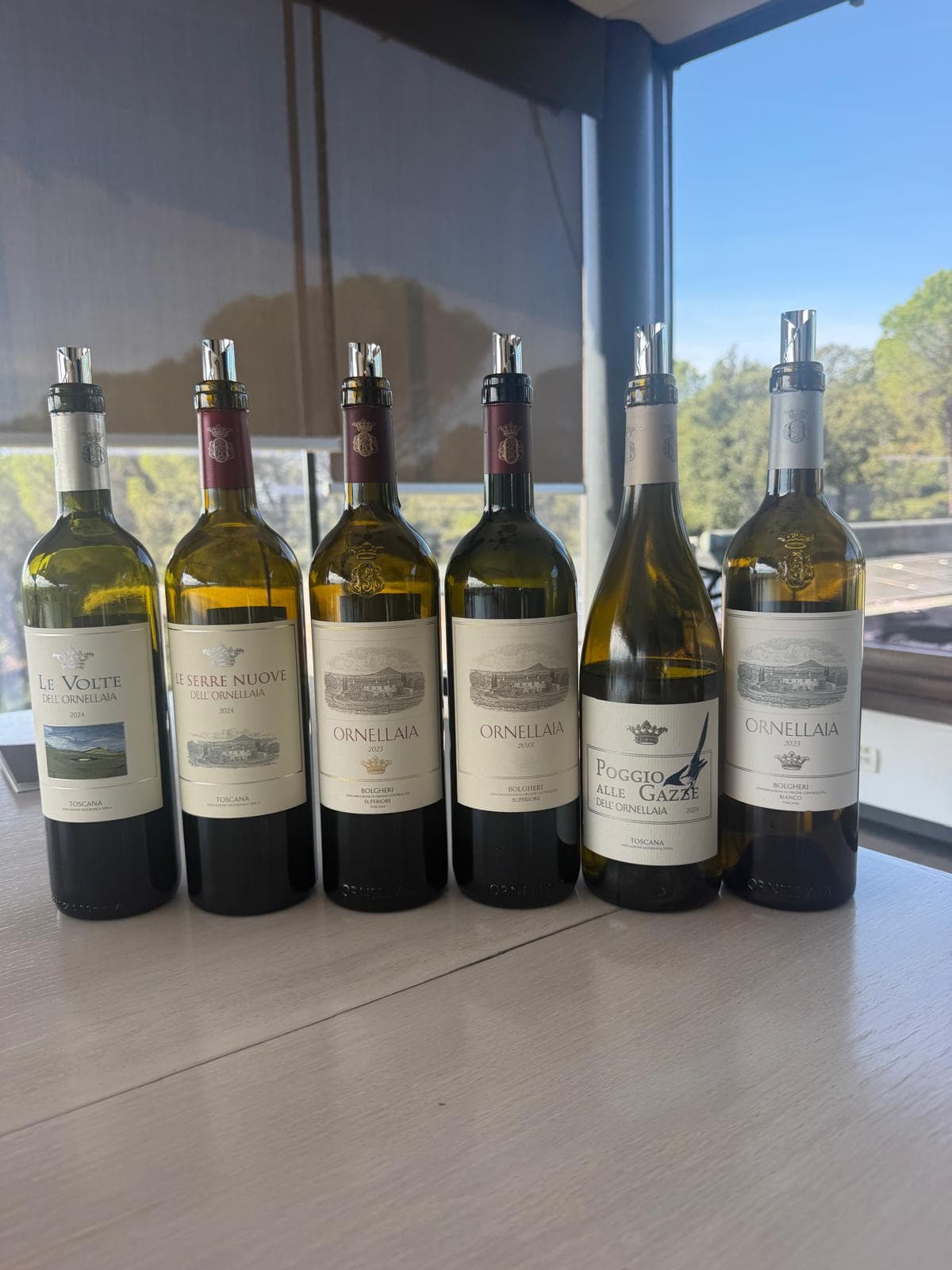
Marco calls the 2023 Ornellaia a benchmark, and I gave it 99 points. It's 55% Cabernet Sauvignon, 26% Merlot, 12% Cabernet Franc, and 7% Petit Verdot, aged 18 months in French oak, 60% of it new. The wine is intense and lavish: sweet baking spice, dusty purple rose, boysenberry, cassis, and mocha powder over dusty tannins. Following the estate's normal routine, the bottle was opened around 9:30 that morning and never decanted. It should be at its best starting in 2028 and has 30 years or more in front of it.
The 2013 Ornellaia (98 points) shows where a cool, low-yield year can go. May rain cut the crop, and the summer was sunny without being hot. At 13 years old the wine is still remarkably fresh, with ripe strawberry, black cherry, worn leather, and tertiary hints of truffle and cigar box. It also has an unusually large share of Merlot, 38% against the estate's average of about 25%. Asked about older vintages, Marco named 1985 among the greatest and said 2006 is his favorite right now, for the way it balances age with the energy it has kept.
Ornellaia's whites need their own space. The estate has 13 hectares of white grapes, mostly Sauvignon Blanc, plus Vermentino and small plots of Viognier and Sémillon. The 2024 Ornellaia Poggio alle Gazze (94 points) is 55% Sauvignon Blanc and 40% Vermentino with a little of each minor grape. It's raised in new and used French oak, amphora, glass globes, and concrete eggs, and it's intensely aromatic, with green Anjou pear, gooseberry, bitter almond, and honeysuckle.
The 2023 Ornellaia Bianco, which I scored 97 points, is pure Sauvignon Blanc from a few high plots near the woods, on deep, cool limestone with about 20% clay. Marco uses 2 or 3 coopers in Burgundy to find barrels gentle enough for the grape. The wine is dense, salty, and mineral, with a faint brioche note and a slight grip of tannin. Served blind, few people would name the variety. The first vintage was 2013, and the estate has just picked its 13th. Marco also showed us a photo of Belaria, a new plot of almost pure limestone being readied for planting. It will be Cabernet Sauvignon, though he admitted Cabernet Franc tempts him there.
If $340 for the grand vin is too much, the 2024 Ornellaia Le Volte is a standout at $30. I scored it 93 points and named it a Best Buy. Expect red cherry, dried chamomile, tomato leaf, and a touch of gravel road, after 10 months in neutral French oak. For the cellar, I'd pick the 2024 Ornellaia Le Serre Nuove (95 points), a blend of 49% Merlot, 21% Cabernet Sauvignon, 17% Petit Verdot, and 13% Cabernet Franc. That's a lot of Petit Verdot, and Marco's reason was simple: the grape was just beautiful in 2024.
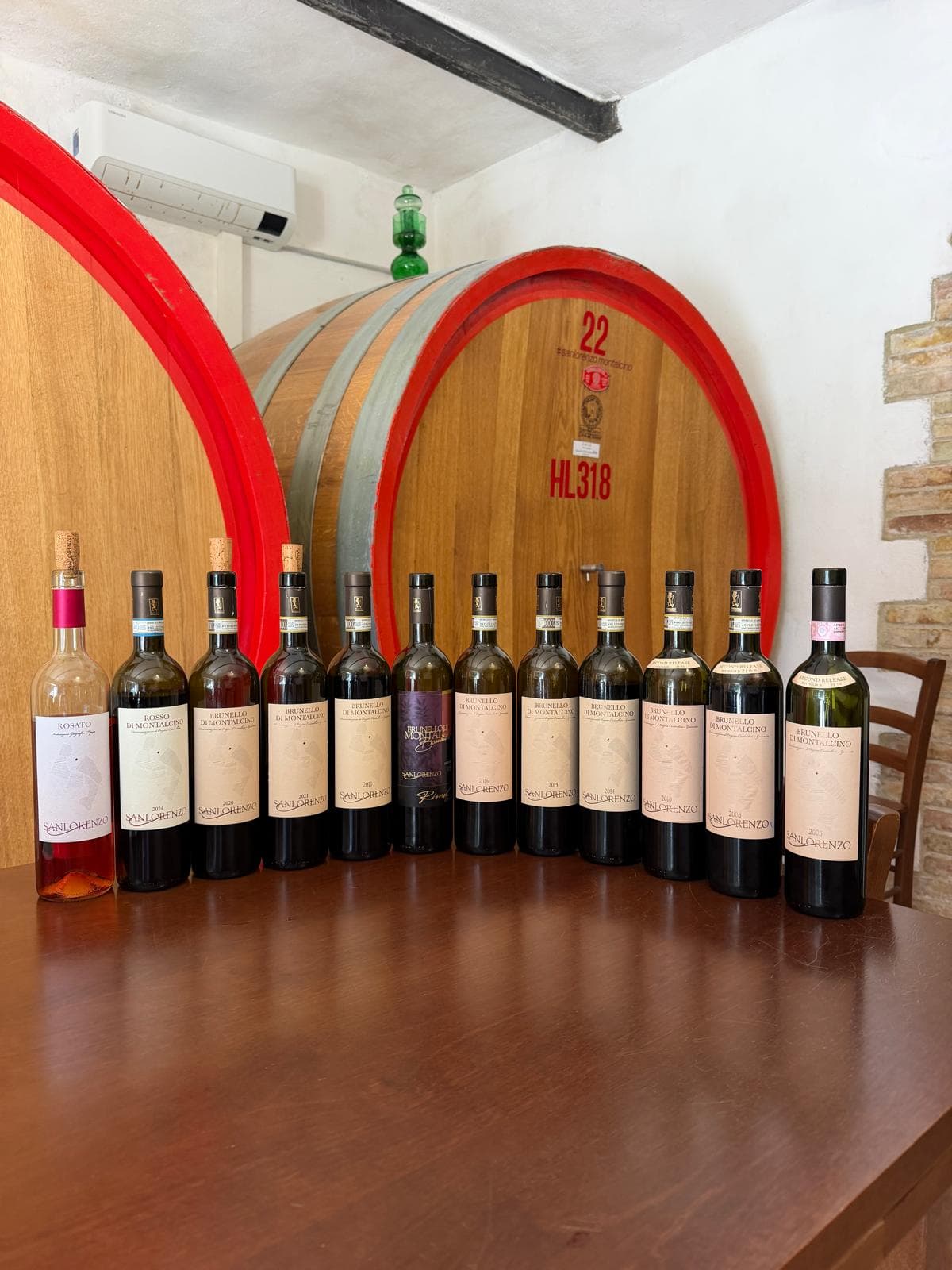
San Lorenzo in Montalcino
Luciano Ciolfi is the third generation to work this land in southwest Montalcino, and he's a farmer before anything else. His family kept livestock, grew grain, and sold grapes to other wineries. When Luciano came back, he wound down the animals and planted vines in the late 1990s, and the first San Lorenzo wine was the 2003. He farms 7 certified organic hectares at 500 meters, some of the highest vineyards in Montalcino. In cooler decades that height made ripening hard. Now it helps. The grapes can hang longer and reach riper tannins while staying fresh. The galestro and clay soils buffer water both ways, and a steady breeze off the sea, about 6 kilometers away, keeps the leaves dry and disease in check.
In the cellar Luciano keeps to the old ways on purpose. He uses older small barrels and no new oak, and he goes past the appellation's minimums as a habit: 3 years in wood for the Brunello where the law asks for 2, and 4 for the Riserva. Yields are about 4 tons per hectare, and the estate makes 20,000 to 25,000 bottles a year.
The Riserva, Bramante, comes from Miagiva, a single dry slope facing west that gives small bunches and concentrated berries. Luciano only makes it in years that clear his own bar. The Rosso di Montalcino gets a year in bottle before it's sold. He takes the Rosé seriously too: 100% Sangiovese, 12 hours on the skins, half fermented in concrete and half in barrel. It started in 2010 as a summer wine for the family and went on sale in 2014. The 2025 San Lorenzo Rosé (93 points) is made for the table and for the cellar.
San Lorenzo also runs a program you rarely see at an estate this size. Every year Luciano sets aside 5 to 10% of the Brunello and releases it only once he thinks it has reached a higher plateau for drinking. Each release comes with a certificate saying the bottles never left the estate's cellar. The program became official with the 2016 vintage, and some of these later releases are sold in two-bottle cases. For a restaurant or a collector, it's an uncommon chance to buy mature Brunello with guaranteed provenance.
Luciano gave us some history, too. A thousand years ago Montalcino did well on the Via Francigena, the pilgrim road from Rome to northern Europe. When the A1 motorway opened in 1956 and traffic went around the town, it faded, and many local people left farming for jobs in Siena and Grosseto. What turned it around was Banfi's big investment in the 1970s. People resented its size at first, yet it rebuilt Brunello's name overseas and made room for small estates like his to succeed.
Our vertical ran from 2005 through a barrel sample of 2022, and it was one of the best tastings of the trip. The 2019 San Lorenzo Bramante Brunello di Montalcino Riserva, 98 points, is Sangiovese with rare intensity and grace: bright strawberry, lemon thyme, white pepper, crushed limestone, and a finish that goes on and on. The 2016 (97 points) still tastes young at 10 years. Like most Montalcino producers, Luciano prefers it to the riper 2015, a year more in line with American tastes. The 2014 (90 points) beat its reputation, given a season of steady rain and a 30% crop loss.
The 2005, which I scored 98 points, was remarkably fresh for its age, and several people at the table named it their favorite. Luciano calls 2005 unlucky, wedged between the stronger 2004 and 2006. He believes cool years such as 1991 and 1996 have aged better than the much-praised 1997, which can taste flat now, and that night's tasting backed him up. His own favorite vintages are 2006, 2016, 2010, 1991, 1996, and 1997. The 2021 (95 points) is generous and balanced for a warm year, and the 2020 (also 95) is broad and led by fruit. The 2022 barrel sample, picked in the first week of September, already has an iron-rich note and comes out in January 2027.
Poggio di Sotto in Castelnuovo dell'Abate
Piero Palmucci founded Poggio di Sotto in 1989 below Monte Amiata, choosing his parcels on the advice of Giulio Gambelli, the legendary Sangiovese consultant. In 2011 the Tipa family added it to their ColleMassari group. The head winemaker has been in Montalcino since 2009 and at Poggio di Sotto since 2016. He poured only three wines for us, and they were plenty. He thinks of himself as a grower first and says 85% of the finished wine is decided in the vineyard.
Of the estate's 48 hectares, 20 are planted, split into more than 20 small plots from 150 to 480 meters up. The old volcano blocks summer storms, and the range of elevations lets the hand harvest stretch over 35 to 40 days. Castelnuovo dell'Abate is one of Montalcino's warmest corners, which makes the house style a surprise. The wines are fresh and elegant and seldom go over 14.5% alcohol. He gets there with very low yields and early picking, and his neighbors doubted him when he started.
Fermentations use native yeasts. Macerations last 30 to 40 days with gentle pump-overs and no punch-downs, and the wines age in 30-hectoliter Slavonian casks. He likes to pour them a little chilled and never decants them, so they can change slowly in the glass. He calls them chameleons.
The Rosso di Montalcino gets real attention here. Barrels good enough for Brunello regularly go into the Rosso instead, which lifts both wines. The 2023 Poggio di Sotto Rosso di Montalcino, which I scored 94 points, has Bing cherry, pomegranate, red peony, and preserved lemon zest over high acidity and moderate tannins. The winemaker thinks it's showing just 40 to 50% of what it will become. Each year the estate makes about 40,000 bottles of Brunello, 30,000 of Rosso, and 4,000 of Riserva. The Riserva comes from a single vineyard, whichever plot does best that year, so the site isn't fixed.
I can't stop thinking about the 2021 Poggio di Sotto Brunello di Montalcino, which got 99 points from me. Orange blossom, Bing cherry, pressed rose, and preserved lemon come first, with a briny streak under dried wild herbs. Grippy tannins and perfectly judged acidity keep the full body in line. The winemaker sees 2021, a drier, hotter year much like 2019, as having more long-term potential than 2020, which had more rain and is unusually easy to enjoy right after release. The 2020 Poggio di Sotto Brunello (97 points) has a quiet depth, with wild strawberry, cocoa powder, and dried porcini.
When I asked about his favorite vintages, he picked 2013 and 2018, two years the market passed over, for their nuance and their distinct aromatics. He warned that ordinary producers had a hard time in both. About 2010, an early, warm year, he said the estates that picked early and extracted gently made the wines that lasted. This year's harvest here ended on September 25. And oddly, the estate's biggest market in the United States is Ohio, ahead of New York and California.
Fontodi in Panzano in Chianti
Giovanni Manetti runs Fontodi, chairs the Chianti Classico consortium, and farms the Conca d'Oro, the bowl-shaped valley under Panzano. It faces fully south and has cool nights, so its wines get concentration and freshness together. His father bought the property in 1968 as a weekend hobby, and the family moved out from Florence 2 years later. Giovanni was 16 then. By 18 he was fully in charge of the winery, while still going to university.
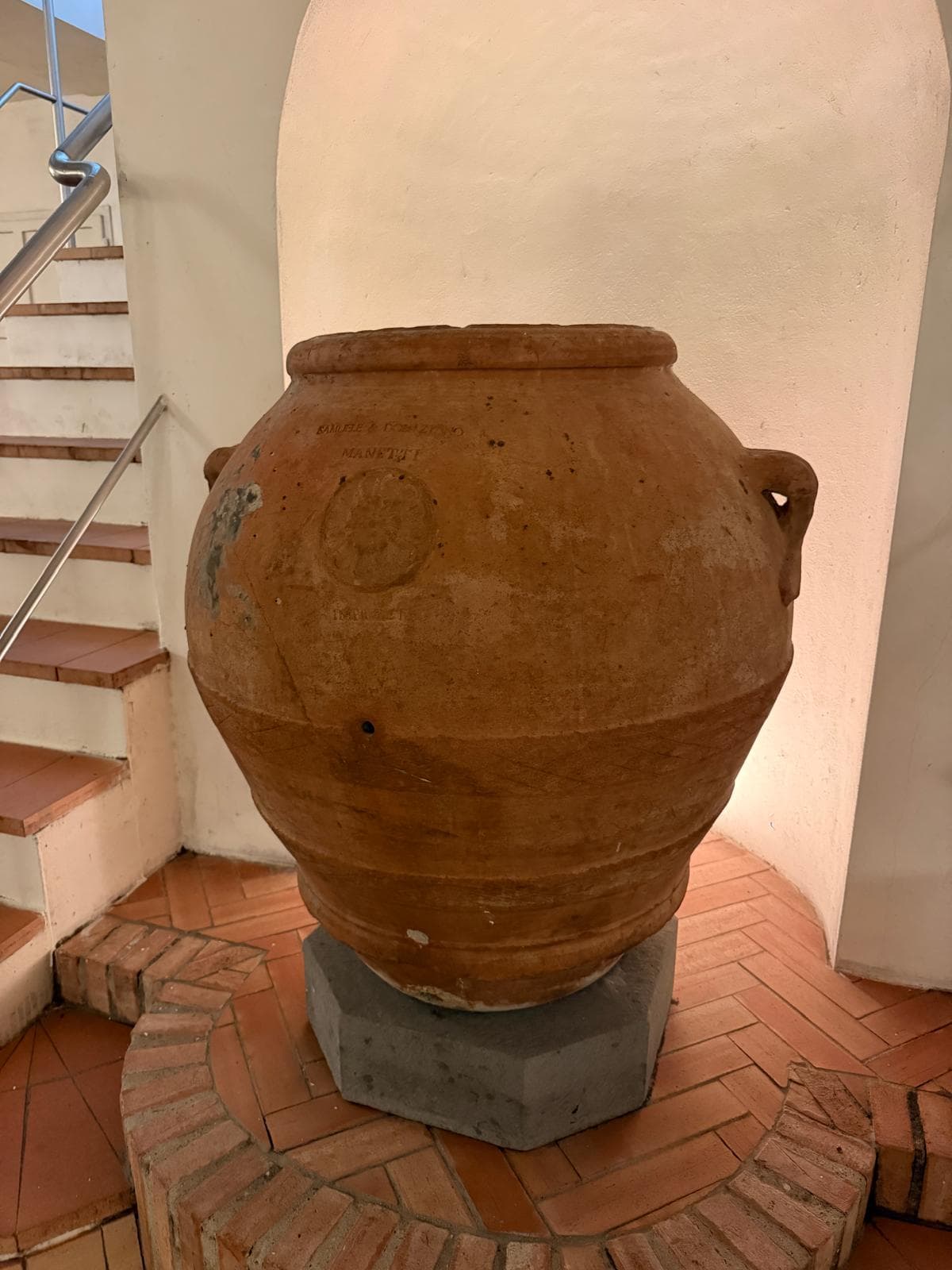
The Manettis run a second business too, a terracotta company founded in 1650. Its tiles cover historic buildings all over Florence, the roof of the Duomo among them. Fontodi has grown about tenfold over the decades by buying neighboring parcels, and today it makes about 25,000 cases a year, all from its own fruit.
The ground under Panzano changes a lot over a short distance. There's limestone on one side of the valley, schist in the middle, and below the village a hard calcareous sandstone called pietraforte. Fontodi has been organic since 1990 and biodynamic since the early 2000s, and 60 cows on the farm provide the manure for its compost. Giovanni was proud to tell us that 60% of Chianti Classico is now organic and that Panzano leads at about 95%.
With summers getting hotter, the estate has stopped cluster thinning and leaf pulling altogether. The goal is as much shade on the grapes as possible, with the ground kept covered to hold in moisture. On the hottest days a local app flags the next day red, yellow, or green, and crews work only from 6 in the morning until noon. Mildew took 30 to 40% of Fontodi's crop in 2023, but the vines that were left had lots of leaves for little fruit, and the wines came out unexpectedly rich.
The winery is stacked on several levels so gravity does most of the moving. Grapes go through three double-sorting lines, and fermentation starts on its own within 24 hours. Extraction is slow: 2 punch-downs a day, 1 pump-over for oxygen, and macerations of a month or longer for the top wines. Each parcel is fermented and aged on its own until the final blend. The top wines spend their first year in low-toast French barriques, about a third of them new, and their second in large French casks. Twenty years ago Fontodi gave them 2 years in barrique. Bottling only happens on a descending moon, and the wines then rest 6 to 12 months in a dark room before release. Giovanni also makes a Gran Selezione in amphora from Lamole, dedicated to his father, Dino. The nights there are especially cool, and the wine is crisp and pure, with no oak at all.
Flaccianello's first vintage was 1981. Chianti was awash in overproduction then, and the rules still demanded at least 15% white grapes in every bottle. A few producers answered by bottling pure Sangiovese as vino da tavola. Flaccianello, along with Tignanello, Le Pergole Torte, and Cepparello, forced the rule change that came in 1984.
The 2023 Fontodi Flaccianello (98 points) comes from 3 parcels along the top of the hill and ages 2 years in French oak. Ripe black cherry, marionberry, dried iris, mulled holiday spice, and a pinch of whole clove come first, then toasted walnut shell and cocoa powder on the palate. It's powerful and elegant in the same breath. The 2023 Fontodi Vigna del Sorbo Chianti Classico Gran Selezione (96 points) draws on three parcels on schist with vines 50 to 63 years old, and it's more savory, with blackcurrant and wild thyme over chalky tannins. The 2023 Fontodi Chianti Classico, which I scored 94 points, is all Sangiovese, aged 2 years in seasoned oak with no new wood. It's concentrated and plush, with violet petals, baked marionberry, and cured meat. The 2024 Fontodi Meriggio (94 points) is a Sauvignon Blanc split among stainless steel, amphora, and 600-liter French oak, and it ends on grapefruit pith and salt. At $61, it's the least expensive way to drink Fontodi.
Giovanni's son, Bernardo, now shares the winemaking, and his daughter, Margherita, runs communications, so the next generation is in place. Looking back, he likes 2016 better than 2015 and 1999 better than 1997, and he picked out 1993 as a cooler year that felt rigid early on and then aged gracefully. As we left, the family gave us a bottle of the 2016 Flaccianello, which Giovanni said critics broadly agree is the most successful vintage of that wine. It's coming back to Seattle with us for an anniversary dinner at the Italian restaurant where Taylor and I had our first date more than 7 years ago.
Rotta Segreta, Toscana
A friend supplied the final wine of the trip. Claudia Callegari has the WSET Diploma, lives in Piombino with a view of the sea, and works near Bolgheri. For the past 4 years she's been building a wine club that sells only Tuscan wine. From May to October she stays on the coast running private tastings and fundraisers. In winter she travels abroad to pour Tuscan wine, and a trip to Washington is planned for next April.
The club has about 150 members and a weekly newsletter that reaches roughly 3,000 readers every Thursday. Members fill out a survey before each shipment so the wines match what they actually drink. She also picks a dozen Italian wines, San Lorenzo among them, for the Ritz-Carlton cruise program through June 2027.
Rotta Segreta, Italian for "secret route," is her own label, and the 2022 Sangiovese is her own wine, aged 18 months in 10-hectoliter oak casks. I scored the 2022 Rotta Segreta Sangiovese 92 points. It has an orange-ruby core and smells of dark cherry, rose petals, iron earth, and damp autumn leaves. On the palate come black plum, bramble, and a dusting of mocha, held in by firm tannins and moderate-plus acidity. Pour it with pappardelle in a slow-cooked meat ragù. We drank it over a long dinner that turned into an argument over whether people remember a wine for its story or for its quality. Claudia's answer, no surprise, is that it takes both.
Where I'd Spend My Money
If you act on one thing from this trip, buy Montalcino 2021. The 2021 Poggio di Sotto Brunello and the 2021 San Lorenzo Brunello both deserve 10 years or more in the cellar. On the coast, chase 2023: the 2023 Ornellaia and the 2023 Grattamacco Bolgheri Superiore are the best of Bolgheri. In Chianti Classico, the 2023 Fontodi Flaccianello is one for long aging, and the 2022 Riservas from Selvapiana and Badia a Coltibuono will pay off if you wait. Open the 2024s now, and go looking for that year's Bolgheri whites, which surprised me. And if a 2019 San Lorenzo Bramante Riserva ever turns up on a wine list, order it before anyone else can.
Reviewed in this article
The wines
All 62 bottles I wrote up for this piece, with my scores. Click a wine for the full review.
Trebotti
- 2021 GocceLazio IGT93
- 2013 GocceLazio IGT93
- 2007 IncanthusColli Etruschi Viterbesi (Tuscia) DOC93
- 2025 BludomLazio IGT92
- 2023 3S GrechettoLazio IGT92
- 2022 CastiglioneroColli Etruschi Viterbesi (Tuscia) DOC92
- 2021 3S SangioveseLazio IGT92
- 2024 IncanthusColli Etruschi Viterbesi (Tuscia) DOC91
- 2024 TuscoColli Etruschi Viterbesi (Tuscia) DOC91
- 2025 3S Aleatico RosatoLazio IGT88
Fattoria Selvapiana
- 2010 Chianti Rufina Riserva Bucerchiale95
- 2020 Chianti Rufina Riserva Vigneto Erchi94
- 2024 Chianti Rufina93
- 2022 Chianti Rufina Riserva Bucerchiale93
- 2020 FornaceToscana IGT93
- 2015 Chianti Rufina Riserva Bucerchiale93
- 2024 Petit MansengToscana IGT92
- 2024 Pomino Bianco Villa di Petrognano92
- 2022 Pomino Rosso Villa di Petrognano92
Sanlorenzo
- 2019 Brunello di Montalcino Bramante Riserva98
- 2005 Brunello di Montalcino98
- 2016 Brunello di Montalcino97
- 2006 Brunello di Montalcino97
- 2019 Brunello di Montalcino96
- 2015 Brunello di Montalcino96
- 2010 Brunello di Montalcino96
- 2022 Brunello di MontalcinoBarrel sample95to 96
- 2021 Brunello di Montalcino95
- 2020 Brunello di Montalcino95
- 2025 RosatoToscana IGT93
- 2023 Rosso di Montalcino93
- 2024 Rosso di Montalcino92
- 2014 Brunello di Montalcino90
Looking for something else? Search every review by winery, region, vintage or score.
Get the reviews by email
One email per bottle
When I publish the next review, you get it. No digests, no roundups. Unsubscribe whenever.